
AI-resilient careers in India
Table of Contents
A few months ago, a young diploma student asked a question many Indians are quietly thinking about: “If AI can write, design, analyse data and even code, what should I learn now?”
It is a reasonable fear. AI is already changing routine office work, customer support, content production and software development. Yet the more useful question is not, “Which job will AI never touch?” Almost every career will be affected in some way.
The better question is: Which careers become stronger when a person knows how to use AI, while still depending on human judgment, trust, domain knowledge, communication or physical-world skills?
Those are AI-resilient careers.
India’s job market is not simply moving toward “more AI jobs.” It is moving toward jobs in which people can combine AI tools with a real professional skill. The World Economic Forum identifies AI and big data, cybersecurity and technological literacy among the fastest-growing skills, while analytical thinking, creativity, resilience, leadership and collaboration remain highly valuable. Government data also shows that AI-related job postings in South Asia increased from 2.9% to 6.5% of vacancies between January 2023 and March 2025, with demand for AI skills rising faster than demand for non-AI roles.pib.gov+3
So, whether you are a student, teacher, diploma holder, government employee, small-business owner or mid-career professional, the goal is not to compete with AI at tasks it can do quickly. The goal is to become the person who can direct it, verify it and apply it to a real problem.
What does AI-resilient mean?
An AI-resilient career is not a job guaranteed to remain unchanged forever. No honest career adviser can promise that.
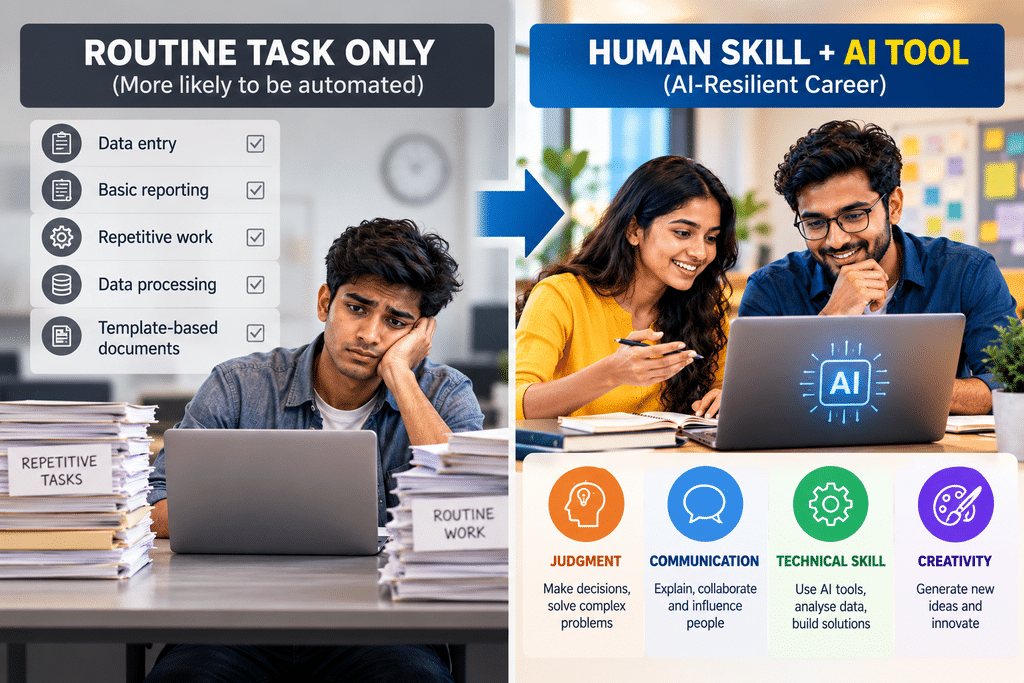
It is a career built around one or more abilities that remain difficult to automate completely:
- Making decisions when information is incomplete
- Taking responsibility for outcomes
- Understanding people, emotions and local context
- Working safely in physical environments
- Combining knowledge from more than one field
- Building trust with customers, students, patients or teams
- Checking whether an AI-generated answer is accurate, lawful and ethical
- Turning a tool’s output into a useful real-world result
This distinction matters because many employers are planning to recruit people with AI skills, even as some also expect automation to reduce particular tasks or roles. The safest strategy is therefore not to ignore AI and not to chase every new tool. Build a valuable core profession, then use AI as leverage.weforum+1
Eight resilient career paths
AI-assisted teacher or trainer
AI can create a quiz in seconds, but it cannot fully understand why one student has stopped participating, why another is afraid to ask questions or how a lesson should be adapted to a particular classroom.
Teachers, corporate trainers, vocational instructors and instructional designers can use AI to prepare lesson plans, bilingual explanations, assessments and personalised practice. Their human advantage lies in motivation, mentoring, classroom management and judging whether the material is actually suitable.
Good fit for: Teachers, lecturers, trainers, subject experts and experienced professionals moving into training.
Skills to combine: Subject expertise, instructional design, presentation, assessment creation, fact-checking and responsible AI use.
Portfolio project: Create a seven-day micro-course on a topic you know well. Include a lesson plan, bilingual notes, assessment, answer key and a short video explanation.
India’s future-skills outlook specifically projects stronger demand for teaching, mentoring and multilingual abilities. Skill India’s SOAR initiative also includes an “AI for Educators” pathway as part of its foundational AI-skilling programme.pib.gov+2
Cybersecurity analyst
The more organisations digitise their work, the more they need people who can protect systems, investigate unusual activity and explain risks to non-technical users.
AI can help detect patterns and summarise alerts, but a human analyst must still decide whether an incident is genuine, understand its business impact and coordinate the response. Security work also involves accountability; a company cannot simply say, “The algorithm made the decision.”
Good fit for: Computer-science, IT, electronics and networking students; system administrators; technically curious career changers.
Skills to combine: Networking, operating systems, identity management, security operations, incident reporting and AI-assisted threat analysis.
Portfolio project: Build a home lab, document five common attacks and publish a simple incident-response checklist for a small college or business.
Security-management roles are among the fastest-growing categories projected for India, while networks and cybersecurity rank among the fastest-growing skill areas.reports.weforum+1

Data and business-intelligence analyst
Businesses rarely suffer from a shortage of data. They suffer from a shortage of people who can ask the right question, clean unreliable information and explain what the numbers mean.
An AI tool can suggest a chart or write a formula, but it does not automatically understand the organisation’s definitions, hidden data-quality problems or decision-making context. A good analyst combines spreadsheet skills, SQL, dashboards, statistics and business understanding.
Good fit for: Commerce, management, engineering, economics and science graduates; office professionals who already work with reports.
Skills to combine: Excel or spreadsheets, SQL, Power BI or another dashboard tool, basic statistics, data storytelling and AI-assisted analysis.
Portfolio project: Analyse a public dataset and create a one-page dashboard with three recommendations. Explain the assumptions and limitations instead of presenting charts alone.
Big-data specialists are among India’s projected fastest-growing roles, and employers increasingly value analytical thinking alongside AI literacy.reports.weforum+1
Industrial automation technician
Factories, utilities, laboratories and infrastructure projects need people who understand machines as well as software. That makes industrial automation a strong path for diploma and ITI students.
AI can predict equipment failure, optimise energy use and assist fault diagnosis. Someone still has to inspect the machine, verify sensor readings, follow safety procedures and restore operations in the real environment.
Good fit for: Diploma or ITI students in electrical, electronics, mechanical, instrumentation, automobile and computer engineering.
Skills to combine: PLC basics, sensors, industrial IoT, preventive maintenance, electrical safety, data logging and AI-assisted diagnostics.
Portfolio project: Build a low-cost sensor-based monitoring prototype or a simulated predictive-maintenance dashboard, then document the fault conditions it can and cannot detect.
Government skilling programmes now cover areas including AI, data analytics, IoT, drones, semiconductors, electric vehicles, renewable energy, robotics and 5G, including delivery through rural and underserved districts.pib.gov+1
Renewable-energy and EV technician
Solar installations, battery systems, charging infrastructure and electric vehicles combine physical equipment with software and data. These roles cannot be performed entirely from a chatbot window.
AI may help estimate energy generation, optimise charging or identify faults. Human technicians still need to install equipment, test systems, follow safety standards, communicate with customers and solve problems at the site.
Good fit for: Electrical, electronics, mechanical and automobile students; field-service professionals.
Skills to combine: Electrical fundamentals, solar or EV systems, battery safety, diagnostic tools, customer communication and digital maintenance records.
Portfolio project: Prepare a basic solar-site assessment or EV charging-station maintenance checklist, including safety risks, cost assumptions and a sample service report.
Climate-mitigation and energy technologies are among the forces expected to shape employment in India through 2030.reports.weforum+1
Healthcare operations and allied health
AI can help organise records, flag risks and support clinical decisions. Healthcare still depends heavily on empathy, careful observation, ethical responsibility and communication with patients and families.
The opportunity is not limited to doctors. Medical-lab technicians, health-information assistants, telehealth coordinators, rehabilitation staff and hospital operations professionals can learn to use AI while remaining grounded in approved procedures and professional boundaries.
Good fit for: Life-science graduates, allied-health students, hospital administrators and healthcare support workers.
Skills to combine: Domain-specific certification, digital records, patient communication, privacy, quality procedures and careful verification of AI-assisted output.
Portfolio project: Design a patient-appointment and follow-up workflow for a small clinic. Show where automation helps and where a trained person must review the information.
Important: AI output must never be treated as a substitute for qualified medical diagnosis or professional clinical judgment.
Digital marketing and content strategist
AI can generate a hundred captions. It cannot guarantee that any of them understands the audience, protects the brand or persuades a real customer.
The resilient version of this career is not “person who produces more generic content.” It is “person who researches an audience, develops a clear offer, runs experiments, interprets results and uses AI to work faster.”
Good fit for: Writers, designers, entrepreneurs, sales professionals and people with strong communication skills.
Skills to combine: Customer research, SEO, analytics, copywriting, visual communication, conversion optimisation and AI-assisted production.
Portfolio project: Create a 30-day campaign for a real local business or educational service. Include audience research, search keywords, content samples, measurement criteria and a post-campaign review.
Creative thinking, technological literacy and service orientation are all expected to grow in importance alongside AI skills.weforum+1
AI governance, compliance and quality assurance
As AI enters banking, education, recruitment, healthcare and government services, organisations need people who can ask difficult questions: Where did the data come from? Is the output biased? Can the decision be explained? Who is accountable when the tool is wrong?
This creates opportunities in AI policy, model evaluation, data governance, privacy, risk, compliance and quality assurance. Not every role requires advanced coding; many require careful reading, domain expertise, documentation and sound judgment.
Good fit for: Law, public policy, management, audit, quality assurance, social sciences and experienced domain professionals.
Skills to combine: Data privacy, risk assessment, documentation, auditing, prompt and output testing, sector regulation and responsible-AI principles.
Portfolio project: Choose an imaginary AI admissions or recruitment tool and conduct a simple risk assessment. Identify possible harms, required human checks and an escalation process.
India’s national skilling ecosystem now includes qualifications and micro-credentials covering AI ethics, security and governance in addition to machine learning and generative AI.pib.gov
Which path fits you?
| Your strength | Consider starting with |
|---|---|
| Explaining and mentoring | AI-assisted teaching or training |
| Solving technical puzzles | Cybersecurity or data analytics |
| Working with machines | Industrial automation, EV or renewable energy |
| Helping people directly | Healthcare operations or allied health |
| Writing, selling or creating | Digital marketing and content strategy |
| Rules, documentation and risk | AI governance, compliance or quality assurance |
Do not choose only by looking at a job title or an impressive salary video. Choose a direction in which you can tolerate the daily work. A person who dislikes troubleshooting will not enjoy cybersecurity for long, just as someone who dislikes communication may struggle in marketing or teaching.
Government-backed learning options
A common mistake is to collect certificates without building any proof of skill. Use courses to learn the basics, but make a project the centre of the plan.
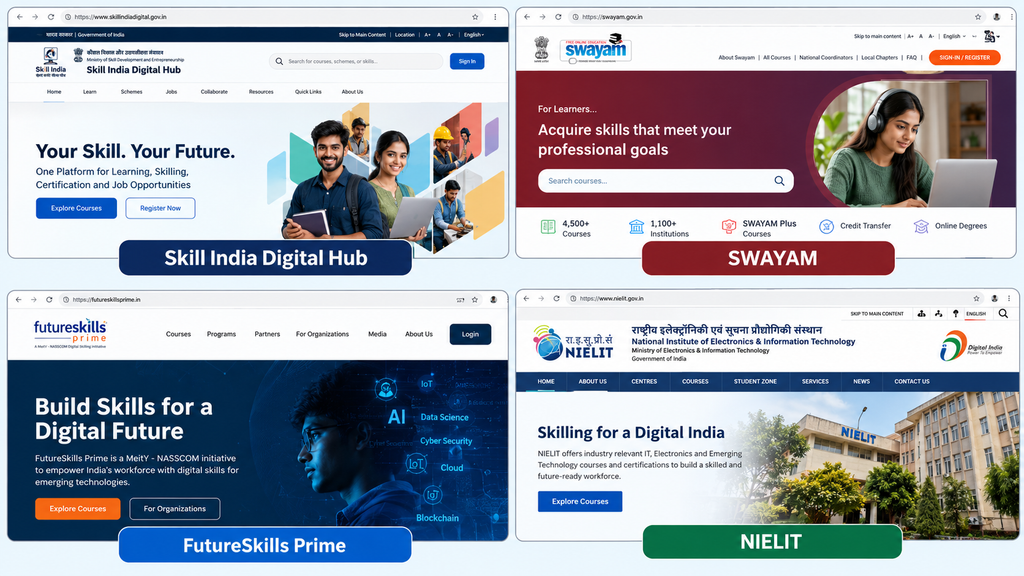
Skill India Digital Hub and SOAR
The Skill India Digital Hub lists introductory options such as SOAR – AI to be Aware, AI for All and Unlocking AI for Everyone. The government says SOAR began with four online, self-paced foundational courses—AI to be Aware, AI to Acquire, AI to Aspire and AI for Educators—and later expanded into AI and application-oriented qualifications.pib.gov+3
Best for: Complete beginners, educators and learners who want structured AI literacy before choosing a specialisation.
Start here: Visit Skill India Digital Hub, create an account and search for “SOAR” or the exact course title. Availability and enrolment conditions can change, so check the course page before joining.
SWAYAM and NPTEL
SWAYAM hosts courses from institutions including IITs, IISc, IIMs and other national coordinators. Course access is free, but a learner who wants a formal certificate may need to register and pay for a proctored examination. NPTEL similarly states that enrolment and learning are free, while its optional certification examination normally carries a fee.nptel+3
Recent SWAYAM listings have included Fundamentals of Artificial Intelligence, AI foundations and algorithms, AI governance, robotics applications, AI for teaching and learning, and business intelligence. Many dated cohorts close after the semester begins, so search for the next session or use available self-study material rather than relying on an old enrolment link.swayam.gov
Best for: Learners who want academically structured study and can commit several hours each week.
FutureSkills Prime
FutureSkills Prime is a joint digital-skilling initiative of MeitY and nasscom, with pathways in AI, big data, cybersecurity, cloud, IoT and other emerging technologies. Its catalogue includes free learning options as well as paid programmes, and some eligible learners may receive government incentives; the platform should be checked for current eligibility and availability before paying.futureskillsprime+4
A beginner may start with a short AI foundation course or the Yuva AI for All programme, which covers basic AI concepts, generative-AI use, responsible prompting and safe practices.campaign.futureskillsprime
Best for: Students and professionals seeking industry-oriented pathways, competency diagnostics and digital badges.
INDIAai learning resources
The INDIAai portal provides a learning section with courses and resources across AI and machine learning, including beginner material. It is useful as a discovery portal when you want to compare subjects before committing to a longer programme.indiaai
Best for: Exploring AI topics and finding learning resources connected to India’s broader AI ecosystem.
NIELIT Virtual Academy
NIELIT’s virtual platform lists programmes in generative AI, agentic AI, Python, AI and machine learning, and other digital areas. Some offerings are free, some low-cost and others are substantial paid programmes; fees, dates and eligibility must be checked on the live course page.nva.nielit+2
Best for: Learners who want practical government-institution training and can verify that the current batch suits their level.
A practical 90-day roadmap
The plan below assumes about 60 to 90 minutes on weekdays and three hours over the weekend. If you have less time, extend the plan; do not sacrifice the project merely to finish in exactly 90 days.
Days 1–15: Understand AI
The first two weeks are about removing confusion.
- Complete a beginner AI-literacy course such as SOAR – AI to be Aware, AI for All or another suitable introductory programme on an official platform.skillindiadigital+1
- Learn the basic difference between AI, machine learning and generative AI.
- Practise writing clear instructions, adding context and checking output.
- Learn basic AI safety: never upload confidential institutional, financial, student, patient or customer data into an unapproved tool.
- Keep a learning diary with one useful application and one limitation discovered each day.
Milestone: Explain in plain language what AI can and cannot do in your chosen career.
Days 16–30: Choose one track
Now stop browsing every possible career.
- Select one career path from the list above.
- Read 20 real job descriptions from reputable employers or job portals.
- Create a spreadsheet of recurring skills, tools, qualifications and experience requirements.
- Identify three skill gaps you can realistically address in the next 60 days.
- Enrol in one relevant course—not five.
Milestone: Produce a one-page career map containing a target role, required skills, learning source and portfolio project.
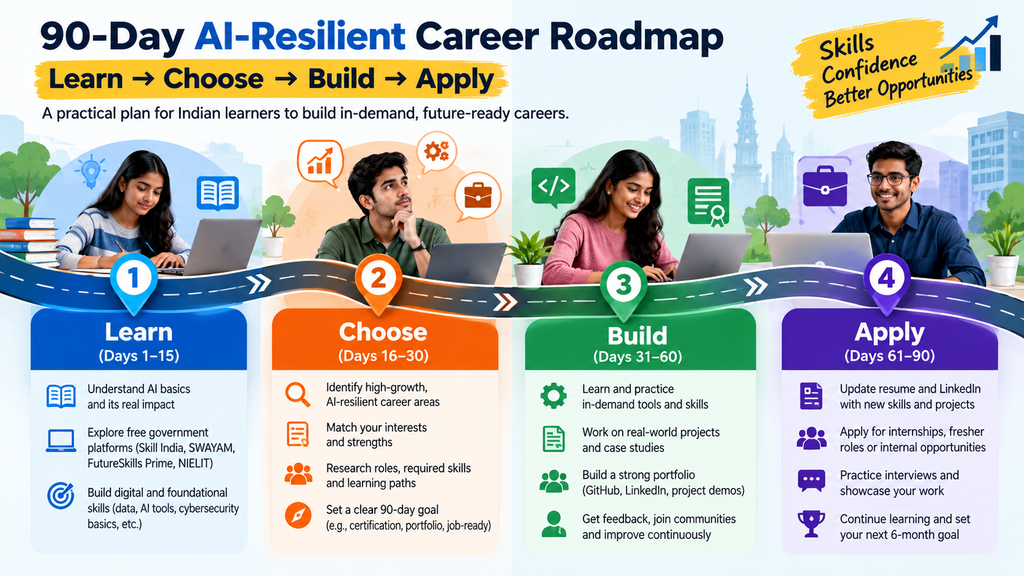
Days 31–60: Build proof
This is the most important stage. Employers cannot assess motivation from a certificate alone; they need evidence that you can use what you learned.
- Build one small but complete project related to your chosen path.
- Use AI for brainstorming, debugging, translation or documentation, but verify every important output.
- Keep versions of your work so you can explain what changed.
- Write a short case study: problem, approach, tools, result, limitations and next improvement.
- Ask a teacher, colleague or practitioner for feedback and revise the project.
Milestone: Publish one portfolio-ready project on GitHub, LinkedIn, a personal website or a shareable PDF, depending on the field.
Days 61–75: Add human value
AI knowledge becomes more valuable when paired with communication and judgment.
- Record a two-minute explanation of your project without reading a script.
- Write a simple version for a non-technical audience.
- Add an ethics, safety or quality checklist relevant to the field.
- Practise verifying sources and identifying hallucinated or unsupported AI output.
- Help one real person or small organisation apply your work, even on a limited pilot basis.
Milestone: Demonstrate that you can explain, defend and safely apply your work—not merely operate a tool.
Days 76–90: Enter the market
The final stage turns learning into opportunity.
- Rewrite your CV around skills and outcomes, not course attendance.
- Add the portfolio link near the top.
- Update LinkedIn with a precise headline such as “Diploma Electrical Engineer | Solar and EV Diagnostics | Learning AI-Assisted Maintenance.”
- Prepare three short stories about problems you solved, mistakes you corrected and feedback you used.
- Apply to a focused list of internships, apprenticeships, freelance projects or entry-level roles.
- Send personalised messages to alumni, instructors and practitioners rather than mass-copying the same request.
- Continue improving the same portfolio project based on market feedback.
Milestone: Complete 20 targeted applications or professional conversations, with each one connected to a relevant role.
The one-plus-one rule
If the 90-day plan feels complicated, remember one formula:
One domain skill + one AI skill = a stronger career profile.
Examples:
- Electrical maintenance + AI-assisted fault diagnosis
- Teaching + AI-supported lesson design
- Accounting + automated reporting and anomaly checking
- Marketing + AI-assisted research and analytics
- Law or audit + AI governance
- Healthcare operations + responsible AI workflow support
- Cybersecurity + AI-assisted threat analysis
“Prompt engineer” may sound exciting, but prompt writing alone is rarely a durable professional identity. A person who understands a domain, asks good questions, verifies answers and takes responsibility for the result is much harder to replace.
Mistakes to avoid
- Collecting certificates without projects: A certificate proves participation; a project shows application.
- Learning too many tools: Tool names change quickly. Problem-solving, judgment and communication travel with you.
- Uploading confidential data: Never paste sensitive workplace, student, patient or financial information into an unapproved AI service.
- Trusting output without checking: AI can produce confident but inaccurate answers.
- Calling any job completely AI-proof: Roles change. Resilience comes from adapting, not from standing still.
- Paying without verification: Confirm course fees, certification conditions, deadlines and incentive eligibility on the official portal.
- Using AI to fake expertise: Be ready to explain every line, chart, design or recommendation in your portfolio.
Frequently asked questions
Which career is safest from AI in India?
No career is completely protected from technological change. Careers involving judgment, accountability, human relationships, physical work and specialised domain knowledge are generally more resilient when professionals also learn to use AI effectively.
Can a non-technical person build an AI-resilient career?
Yes. Teachers, marketers, administrators, healthcare workers, legal professionals and small-business owners can combine their domain knowledge with AI literacy. Coding is essential for some roles, but not for every AI-enabled career.
Are government AI courses completely free?
It depends on the platform and course. SWAYAM and NPTEL generally allow free learning, while optional certification examinations may carry a fee. Skill India lists free introductory options, while FutureSkills Prime and NIELIT offer a mixture of free, subsidised and paid programmes.skillindiadigital.gov+4
Is a certificate enough to get a job?
Usually not. A certificate becomes more valuable when supported by a relevant project, clear communication and evidence that you can apply the skill to a real problem.
What if I have only one hour per day?
One focused hour is enough to make progress. Spend roughly 30 minutes learning, 20 minutes building and 10 minutes recording what you learned. Consistency over 90 days matters more than an intense weekend followed by a long break.
Final thought
AI will remove some tasks, redesign many jobs and create new opportunities. Waiting for perfect certainty is therefore not a practical career strategy.
Choose one field where you can solve a real problem. Learn enough AI to work faster, but invest equally in the human abilities that give the work meaning: judgment, communication, responsibility, creativity and trust.
You do not need to become an AI scientist in 90 days. You need to become visibly better at one useful thing—and prove that you can use AI without surrendering your judgment to it.