
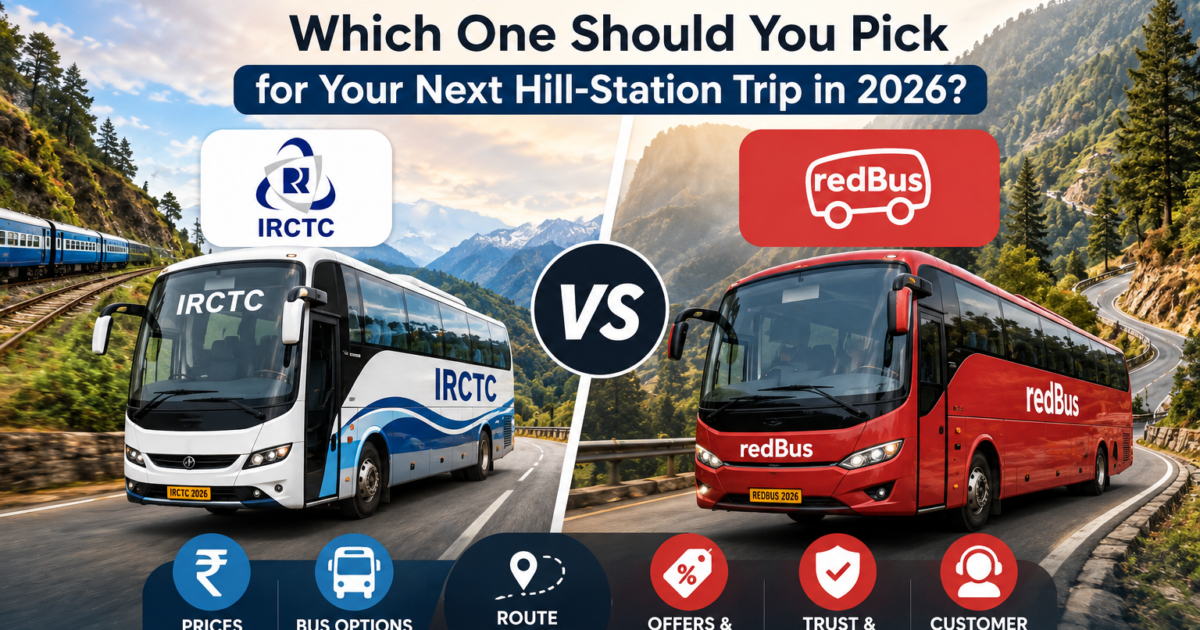
IRCTC vs redBus: You’ve picked your travel dates, blocked the leave, and now you’ve got two browser tabs open — one on IRCTC, one on redBus. Both promise to get you to the mountains, but they’re not really solving the same problem. A train gets you to a station in the valley; a bus can drop you at the market square of the actual hill town. One runs on a government-fixed cancellation schedule that just changed in April 2026; the other’s cancellation policy depends entirely on which operator you book. Here’s how the two actually compare once you look past the booking-page marketing.
Quick verdict
If your destination is Shimla or somewhere in the Dharamshala–Kangra belt and you’re booking three to four weeks out, IRCTC usually wins on price and comfort — there’s a direct line. For almost everywhere else in the Himachal and Uttarakhand hills — Manali, Dalhousie, Kasol, Kullu, Nainital, Mussoorie, Auli — redBus is the more realistic single-ticket option, because no train actually reaches those towns. And if you’re booking inside a week, redBus’s instant confirmation avoids the real risk of an unconfirmed IRCTC waitlist.
IRCTC vs redBus at a glance
| Factor | IRCTC (Train) | redBus (Bus) |
|---|---|---|
| Booking fee | ₹10 + GST (non-AC) / ₹20 + GST (AC) per ticket; no extra charge when paying via UPI | Booking/service/convenience fee added at checkout, amount varies by operator and route |
| Confirmation certainty | Can go to RAC or waitlist, especially in peak season and on Tatkal quota | Ticket is confirmed instantly at booking — no waitlist system |
| Cancellation rule | Fixed nationwide schedule (updated 1 April 2026): flat charge only if cancelled 72+ hours before departure, 25% of fare 72–24 hours before, 50% of fare 24–8 hours before, no refund under 8 hours | Set by the individual bus operator and printed on the ticket — varies trip to trip; some operators allow a one-time free reschedule instead |
| Reaches the hill town directly? | Only where a line exists — Shimla and the Kangra Valley belt; most hill towns need a taxi or bus onward from the railhead | Most AC/Volvo routes drop inside or near the town itself |
| Comfort | Sleeper/3AC/2AC berths; smooth ride on the plains and the toy-train stretch into Shimla | AC sleeper options on major hill routes; ride quality depends on the mountain road itself |
Does it actually go where you’re going?
This is the question that decides everything else, and it’s the one most people skip. Himachal Pradesh’s rail network is genuinely small: the Kalka–Shimla toy train (about 6 hours) is the only direct line into Shimla, and the Kangra Valley Railway (Pathankot to Jogindernagar, roughly 8 hours) serves the Dharamshala, Bir Billing, Palampur, and Kangra belt. Manali, Dalhousie, Khajjiar, Kullu, and Kasol have no direct rail access at all — you’d land at a railhead like Kalka or Pathankot and still need a taxi or bus for the rest of the way. If you’re chasing the kind of off-the-radar stop covered in our guide to hidden villages in Himachal Pradesh, a train alone won’t get you there.
Uttarakhand follows the same pattern. Kathgodam railway station, the railhead for the Kumaon hills, sits about 35 km from Nainital and is the entry point for Almora, Ranikhet, and the rest of that belt — not a station in any of those towns themselves. Dehradun and Haridwar play the same role for Mussoorie and the Garhwal region. In both states, a train gets you to the foothills; redBus (or a taxi from the railhead) does the last leg. Booking a bus directly skips that transfer entirely.
Will your ticket actually be confirmed?
IRCTC tickets for popular hill routes — Kalka–Shimla especially — can go to RAC or the waitlist during long weekends and peak season, and a waitlisted ticket isn’t a guaranteed seat. redBus doesn’t have this problem: a bus ticket is confirmed the moment you pay, and with dozens of operators running the same route, there’s almost always a seat available even a day or two out. If you’re booking less than a week ahead, this single difference can decide which platform you use.
What you actually pay
IRCTC’s convenience fee is small and fixed — ₹10 plus GST for non-AC classes, ₹20 plus GST for AC classes — and UPI payments don’t add anything on top. Base train fares in sleeper and 3AC are also regulated, so they don’t swing much closer to your travel date. redBus fares move the opposite way: prices rise as seats fill up and spike hard around long weekends, and the booking or service fee added at checkout isn’t published as a flat rate — it varies by operator and route, so check it before you confirm. Once you add the cost of a taxi or connecting bus from an IRCTC railhead, the total often lands close to a direct redBus fare anyway — sometimes redBus comes out cheaper for towns the train doesn’t reach.
Cancellation rules if your plans change
Indian Railways restructured its cancellation rules on 1 April 2026. The free-cancellation window widened from 48 to 72 hours before departure, but the no-refund cutoff also moved from 4 hours to 8 hours before departure, with a 25% fare deduction between 72 and 24 hours out and 50% between 24 and 8 hours out. Confirmed Tatkal tickets still aren’t refundable at all. redBus works differently — there’s no single platform-wide rule; each operator sets and prints its own cancellation charge on the ticket, and some let you reschedule once for free instead of cancelling. If your travel dates are firm, IRCTC’s rules are now more predictable; if they’re not, check the specific operator’s policy before you book on redBus. Either way, it’s worth building a buffer into your plans — our ₹500/day India travel guide has more on budgeting for exactly this kind of flexibility.
The ride itself
Trains are the smoother ride for the plains stretch of any hill journey, and the Kalka–Shimla toy train is part of the trip’s appeal in its own right. Buses handle the actual mountain roads more often, simply because they go more places — including the kind of remote, off-grid stop we covered in Disconnected from the Noise: The Giri-Ganga Trek, which isn’t reachable by rail at all. AC sleeper buses on major hill routes now come with reclining seats, charging points, and live tracking, but winding hill-section roads can still be rough if you’re prone to motion sickness — something a train journey mostly avoids.
Pick IRCTC if
- Your destination is Shimla, Dharamshala, or another town on the Kangra Valley line
- You’re booking three or more weeks ahead and want the lower, fixed convenience fee
- The toy-train ride is part of why you’re making the trip
- You’re fine pairing the train with a short taxi or bus ride at the other end
Pick redBus if
- You’re headed to Manali, Dalhousie, Kasol, Nainital, Mussoorie, Auli, or any hill town without a station
- You’re booking inside a week and can’t risk a waitlist
- You want one ticket that gets you into town, with no transfer at a railhead
- You’re travelling solo and want to pick a specific, reviewed operator and seat — worth reading alongside our solo female travel safety guide for Himachal Pradesh before you book
Frequently asked questions
Is IRCTC cheaper than redBus for hill-station trips?
For routes trains actually serve, sleeper and 3AC fares are usually lower than an equivalent AC bus fare, and IRCTC’s convenience fee is a fixed ₹10–20 plus GST. But once you add a taxi or connecting bus for the last leg from the railhead, the total cost often evens out — or tips in redBus’s favour for a town the train doesn’t reach directly.
Can I get a confirmed IRCTC ticket to Shimla during peak season?
It’s possible but not guaranteed. Shimla-bound trains fill up fast around long weekends and the monsoon and summer travel windows, and popular classes can go to RAC or the waitlist. Booking the moment the reservation window opens improves your odds.
Does redBus charge a cancellation fee?
It depends entirely on the operator. Each ticket lists its own cancellation charge, and some operators also offer a one-time free reschedule instead of a straight cancellation. There’s no single redBus-wide cancellation rule the way there is for IRCTC.
What changed in IRCTC’s cancellation rules in 2026?
From 1 April 2026, Indian Railways widened the free-cancellation window from 48 to 72 hours before departure, but also pushed the no-refund cutoff from 4 hours to 8 hours before departure, with 25% and 50% fare deductions in the windows in between.
Which popular hill stations have no direct train at all?
Manali, Dalhousie, Khajjiar, Kullu, and Kasol in Himachal Pradesh, and Nainital, Mussoorie, and Auli in Uttarakhand, have no railway station of their own. All of them are reached by road from a railhead such as Kalka, Pathankot, Kathgodam, Dehradun, or Haridwar.
Verdict
Neither platform is a universal winner, and the honest answer depends on whether a train line actually reaches your hill town. For Shimla and the Kangra belt, book IRCTC and enjoy the ride. For almost everywhere else in the Himachal and Uttarakhand hills, redBus gets you there in one ticket without a railhead transfer — and if you’re still picking a destination, our roundup of the best monsoon destinations for 2026 is a good place to start before you open either booking tab.