
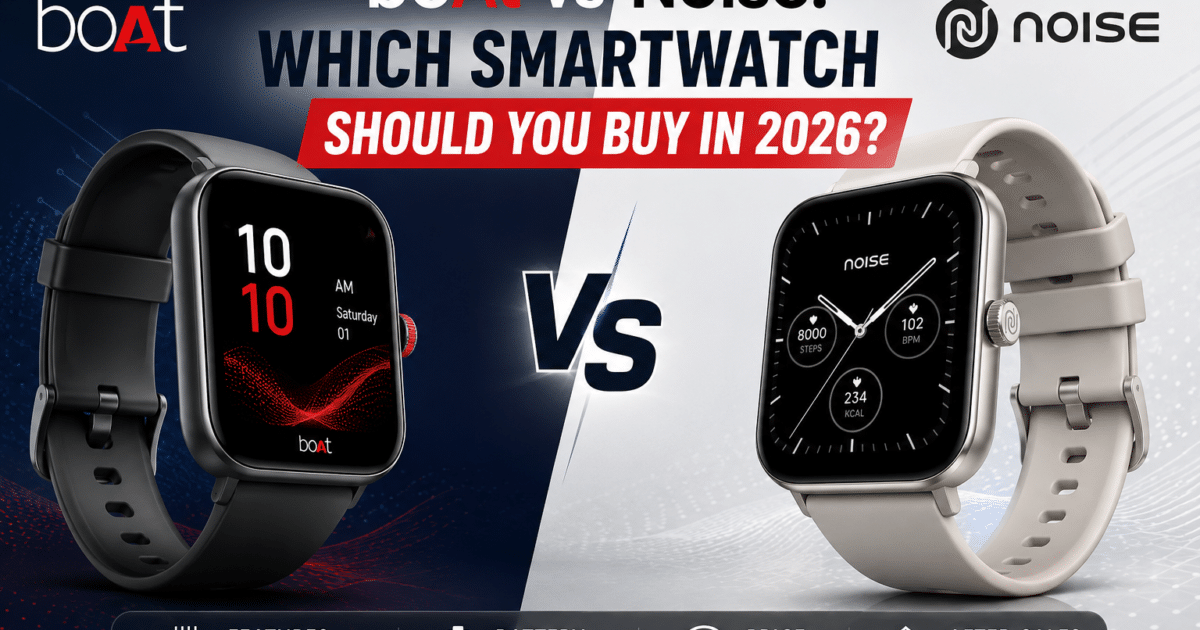
You’re scrolling through Flipkart or Amazon sale banners, and every third smartwatch result is either a boAt or a Noise. Both brands run flash sales practically every week, both spam your Instagram feed with meme-driven ads, and both promise an AMOLED-style display and multi-day battery for under ₹2,000. Somewhere between the endless model names — Storm Call, Wave Sigma, Lunar Atlas, ColorFit, NoiseFit — the actual buying decision gets buried under marketing. This boAt vs Noise smartwatch comparison sticks to real, currently listed models sold in India, at real prices, tier by tier, so you can decide based on what you’re actually getting rather than which ad showed up last.
Table of Contents
Quick verdict: If your priority is the longest battery life and the lowest price for calling plus basic health tracking, boAt wins — the Storm Infinity Max claims up to 20 days on a charge for under ₹1,500. If you want more advanced health sensors, including blood pressure estimation, at the premium end, Noise’s NoiseFit Endeavour Pro pulls ahead, though at nearly double the price of boAt’s flagship. For a first smartwatch under ₹1,500, the two brands are close enough on paper that comfort, strap quality, and app experience should decide it — not the spec sheet.
Here’s how the two brands stack up model-for-model across the four price tiers most Indian buyers actually shop in:
| Price Tier | boAt Model | boAt Price | Noise Model | Noise Price |
|---|---|---|---|---|
| Entry Calling (~₹1,000–1,300) | Storm Call 4 | ₹1,299 | ColorFit Vision 2 Buzz | ₹999 |
| Battery Champion (~₹1,300–1,600) | Wave Sigma 3 Curv (10-day battery) | ₹1,299 | NoiseFit Twist Go | ₹1,599 |
| Mid-Range Health (~₹1,474–2,499) | Storm Infinity Max (20-day battery) | ₹1,474 | ColorFit Pulse 4 Max (7-day battery) | ₹2,499 |
| Premium GPS (~₹4,499–4,999) | Valour Watch 1R (GPS + 4G) | ₹4,499 | NoiseFit Endeavour 2 (GPS) | ₹4,999 |
| Premium+ (₹7,000) | — | — | NoiseFit Endeavour Pro (GPS + BP monitor) | ₹7,000 |
Entry-Level Calling Watches: Storm Call 4 vs ColorFit Vision 2 Buzz
At the very bottom of both catalogues sit the calling watches most first-time buyers start with. The boAt Storm Call 4 (₹1,299) gets a larger 1.96-inch display, Bluetooth calling, IP68 water resistance, and the usual heart-rate and SpO2 tracking. The Noise ColorFit Vision 2 Buzz undercuts it at ₹999, with a slightly smaller 1.78-inch display but the same core feature set — Bluetooth 5.3 calling, IP68 rating, and health tracking. If ₹300 matters more to you than screen size, Noise wins this tier outright. If you want the bigger display for a small premium, boAt’s asking price is still reasonable.
Battery Life: Where boAt Pulls Ahead
This is the clearest differentiator between the two brands right now. boAt’s Wave Sigma 3 Curv (₹1,299) is rated for roughly 10 days per charge, and the Storm Infinity Max (₹1,474) claims up to 20 days — both with Bluetooth calling and IP68 water resistance included. Noise’s comparable models, like the NoiseFit Twist Go (₹1,599) and ColorFit Pulse 4 Max (₹2,499), are generally rated closer to 7 days.
If you hate charging your watch every few days, boAt’s battery-focused models are the safer bet at a lower price.
Health & Fitness Sensors
At the entry and mid tiers, the two brands are near-identical: heart rate monitoring, SpO2 (blood oxygen) tracking, sleep tracking, and IP68 water resistance are standard on both boAt and Noise watches from around ₹1,000 upward. The real gap opens at the premium end. Noise’s NoiseFit Endeavour Pro (₹7,000) adds a blood pressure monitor alongside SpO2 — a feature boAt doesn’t currently offer at a comparable price point. Worth noting: wrist-based blood pressure readings on any consumer smartwatch are estimates, not a medical-grade measurement, so treat this as a wellness feature rather than a diagnostic one.
Premium Tier: GPS, 4G, and Calling Without a Phone
Once you cross into the ₹4,000-plus bracket, both brands add GPS for accurate outdoor tracking. boAt’s Valour Watch 1R (₹4,499) goes a step further with built-in 4G connectivity and Bluetooth calling, meaning it can make calls and stay connected even without your phone nearby — useful for runners who don’t want to carry a handset. Noise’s NoiseFit Endeavour 2 (₹4,999) sticks to GPS and Bluetooth calling tethered to your phone, while the Endeavour Pro (₹7,000) trades the standalone-connectivity angle for the blood pressure sensor mentioned above. If standalone connectivity matters more to you than health sensors, boAt’s premium pick is the more complete package for less money.
Software, App Experience, and After-Sales Support
Both brands ship with companion apps — boAt’s Wave app and Noise’s NoiseFit app — that pair over Bluetooth to show health data, notifications, and let you customize watch faces. Neither app matches the polish of Apple Health or Samsung Health, but both cover the basics reliably: step counts, sleep summaries, and call or message mirroring from your phone. Where it matters more day-to-day is after-sales support — both boAt and Noise sell widely through Flipkart, Amazon, Croma, and Reliance Digital, so getting a replacement or repair isn’t a brand-specific hassle either way.
Pick boAt If / Pick Noise If
Pick boAt if:
- You want the longest battery life for the lowest price (Storm Infinity Max, Wave Sigma 3 Curv)
- You want standalone 4G calling without carrying your phone (Valour Watch 1R)
- You care more about screen size than shaving off the last few hundred rupees
Pick Noise if:
- You want the lowest possible entry price for a calling watch (ColorFit Vision 2 Buzz)
- You want the most advanced health sensor available at the premium tier, including blood pressure estimation (NoiseFit Endeavour Pro)
- You’re comparing two otherwise similar watches and want the brand with the slightly larger sensor lineup
Frequently Asked Questions
Quick answers to the questions people ask most when deciding on a boAt vs Noise smartwatch:
Which is better, boAt or Noise, for calling on a budget?
Noise’s ColorFit Vision 2 Buzz is the cheaper calling watch at ₹999, but boAt’s Storm Call 4 (₹1,299) offers a larger display for a small price difference. Both support Bluetooth calling and basic health tracking.
Does boAt or Noise have better battery life?
boAt currently has the edge. Its Storm Infinity Max claims up to 20 days per charge, well ahead of Noise’s comparable models, which are typically rated around 7 days.
Which brand offers GPS and blood pressure monitoring?
boAt’s Valour Watch 1R (₹4,499) includes GPS and 4G calling. Noise’s NoiseFit Endeavour Pro (₹7,000) is the one with a built-in blood pressure sensor alongside GPS, though at a higher price.
Are boAt and Noise smartwatches worth it over a premium brand like Apple Watch or Galaxy Watch?
For most Indian buyers who want calling, health tracking, and long battery life under ₹5,000, yes — boAt and Noise cover that need well. If you specifically want tighter software integration with an iPhone or a Samsung phone, or app-store access for third-party apps, a premium smartwatch is still the better fit; the trade-off is price, often five to ten times higher.
Do boAt and Noise smartwatches work with iPhone?
Yes, both boAt and Noise smartwatches pair with iPhones as well as Android phones via Bluetooth, though full call-and-message mirroring is generally more complete on Android. Check the specific model’s listing for iOS compatibility notes before buying if you’re an iPhone user.
The Verdict: boAt vs Noise Smartwatch
Neither brand is broadly “better” — they’re optimized differently. boAt tends to win on battery life and gives you more display and connectivity per rupee at the premium tier. Noise tends to win at the very bottom of the price range and pushes further on health sensors once you’re willing to spend ₹7,000.
If you’re also shopping for a phone to pair your new watch with, our best 5G phones under ₹15,000 guide covers similar ground for handsets, and if you already run a flagship, see how the OnePlus 13R holds up as a buy in 2026. For another head-to-head built the same way as this one, check our iQOO Neo vs Poco X comparison or, if productivity apps are more your speed than wearables, our Notion vs ClickUp vs Obsidian breakdown uses the same pick-a-tier approach.